|
Author Guidelines
ANWESA invites original scholarly articles that fall within the broad domain of education and multidisciplinary educational studies. Authors are requested to carefully follow the guidelines below before submitting their manuscripts.
1. Submission Guidelines
-
Manuscripts should be submitted in soft copy via email to: anwesajournal@gmail.com.
-
The manuscript must be prepared in Microsoft Word format (.doc or .docx) using Times New Roman font.
-
The article must be original and unpublished, and should not be under consideration for publication in any other journal at the time of submission.
-
Authors must ensure that the manuscript is free from plagiarism. The similarity index and AI-generated content must remain below 10%.
-
The journal follows a peer-review and refereed evaluation process. The editorial board reserves the right to accept or reject the manuscript based on reviewer comments and editorial standards.
-
Accepted types of manuscripts include:
-
Empirical research papers
-
Review articles and literature reviews
-
Conceptual and theoretical papers
-
Case studies and action research in education
2. Manuscript Preparation
Language and Format
-
Manuscripts should preferably be written in clear academic English.
-
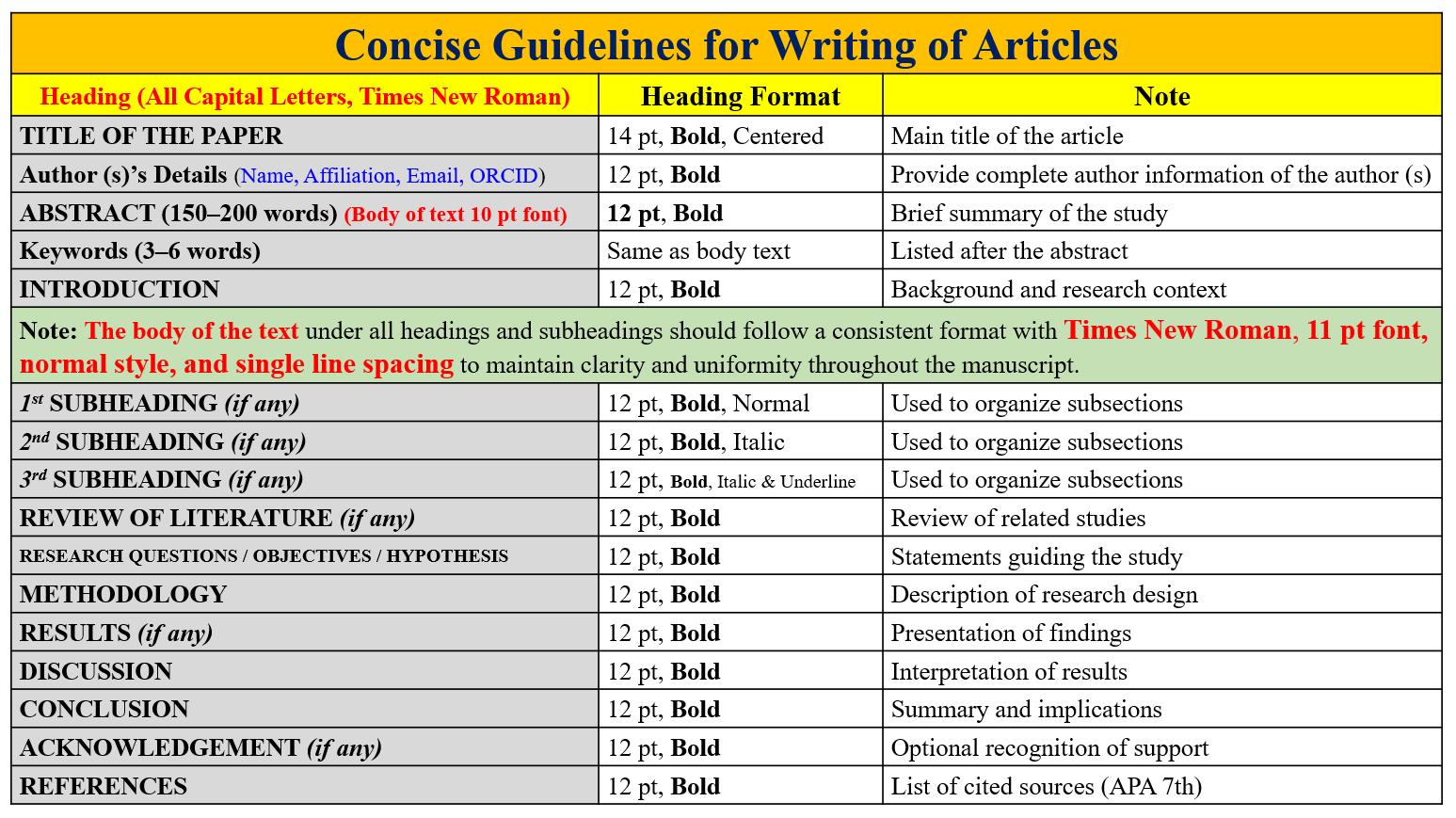
The paper should be typed on A4 size page, single spacing, using Times New Roman. For more details Click Here.
-
The word limit should be between 3500–5000 words, excluding references, tables, and figures.
3. Structure of the Manuscript
A manuscript should contain the following components:
Title
-
The title should be clear, concise, and informative, reflecting the content of the article.
-
Ideally, it should not exceed 15 words.
Author(s) Details
-
Author name(s), institutional affiliation(s), email address and ORCID ID should be provided just below the title.
-
If there are multiple authors, the corresponding author must be clearly indicated.
Abstract and Keywords
-
The abstract should be 150–200 words.
-
It should briefly describe the background, objectives, methodology, key findings, and conclusion of the study.
-
Provide 4–6 keywords immediately after the abstract.
4. Main Body of the Paper
Introduction
-
This section should present the background of the study, context, brief literature review, and research objectives.
-
It should be written in paragraph form and should constitute approximately 15–20% of the total article length.
Methodology / Research Methods
-
Describe the research design, data sources, sampling, tools and techniques of data collection, and methods of analysis.
-
This section should constitute 10–15% of the total article length.
Results and Discussion
-
Present the findings of the study and their interpretation.
-
The discussion should relate the findings to research questions, previous studies, or theoretical perspectives.
-
This section should form the major part of the paper (about 40–60%).
Conclusion
5. Tables, Figures, and Illustrations
-
Tables should use only horizontal lines for clarity.
-
Each table must have a table number and title placed above the table.
-
Figures, diagrams, and charts should have captions placed below the image.
-
All tables and figures must be clearly referred to in the text.
6. Referencing Style
-
The journal follows the APA (American Psychological Association) referencing style.
-
All sources cited in the text must appear in the reference list, and all references must be cited in the text.
-
References should be arranged alphabetically by the author’s surname at the end of the manuscript.
-
Authors are encouraged to use reference management tools such as Mendeley, Zotero, or EndNote.
For more details please follow the article template.
|

